
Xero Credit Note Allocation: Why It's Still Manual
If you need to allocate a supplier credit note in Xero, the credit must be applied to an outstanding bill before it reduces what you owe. Xero supports this, but the allocation is still completed credit note by credit note.
Batchly removes that step by handling credits inside the workflow, so your team can see what is settled by credit and what remains to be paid before anything is processed.
Batchly supports Xero users across Australia, New Zealand, the United States, Ireland, and the United Kingdom. Bank file exports are available for Australia (ABA), New Zealand (ASB MT9, BNZ AFI), and the United Kingdom (NatWest bank file export for UK Xero organisations), and supplier credit note allocation is available across supported Xero regions — Batchly removes that manual step.
For a full guide on running large payment batches in Xero, see Xero Batch Payments: How to Pay More Than 200 Bills in Xero.
This article covers how supplier credit note allocation works in Xero today, why it becomes painful at scale, and how Batchly applies credits automatically during the payment workflow.
What is Xero credit note allocation?
Xero credit note allocation means applying a supplier credit note to one or more outstanding bills before payment. Until a credit note is allocated, it does not reduce the amount payable in a batch payment run.
In Xero, this is a manual process — each credit note must be opened individually and matched to a bill.
It becomes painful when suppliers have multiple outstanding bills, multiple credit notes, or when a single run mixes credit-only, credit-plus-cash, and cash-only outcomes across dozens of suppliers.
Batchly calculates the allocation automatically during the payment run and writes it back to Xero before the cash payment is processed, removing the manual step entirely.
What Are Supplier Credit Notes in Xero?
Supplier credit notes in Xero are credits issued by suppliers to reduce the amount you owe. They are commonly created for returned goods, pricing adjustments, or invoice corrections.
To use a supplier credit note, it must be allocated to one or more bills. Until that happens, it does not reduce the total payable amount in your payment run.
How to Allocate a Supplier Credit Note in Xero
To apply an existing supplier credit note to an outstanding bill in Xero:
- 1Open Purchases, select Bills, then open the Awaiting Payment tab.
- 2Find and open the supplier credit note you want to apply.
- 3Open the options menu and select Allocate Credit.
- 4Enter the amount to credit beside the relevant outstanding bill or bills.
- 5Select Allocate Credit to confirm the allocation.
Xero documents the same workflow in its guide to applying a supplier's credit to a bill.
Can't see Allocate Credit?
Check that the credit belongs to the same supplier as the bill, and that the bill is still awaiting payment and is not dated inside a locked period. Xero allows a credit transaction dated in a locked period to be applied to a bill outside the locked period.
This works for a handful of credits. But when you're running Xero batch payments with dozens of suppliers carrying outstanding supplier credit notes, it becomes a bottleneck before the payment run even starts.
Why This Becomes Difficult at Scale
Supplier credit note allocation in Xero is manageable at low volumes. But for operational businesses, the manual effort compounds quickly:
- High-volume suppliers with frequent returns — wholesale, manufacturing, and distribution businesses regularly process supplier credits for returned or defective goods
- Stock adjustments and inventory credits — price corrections, volume rebates, and credit adjustments accumulate across dozens of supplier accounts
- Construction and trade businesses with progress claims — variations, retention releases, and back-charges generate supplier credits that must be matched before payment
- Large batch payment runs with dozens of supplier credit notes — when a single payment cycle involves 50+ suppliers, even a few credits per supplier means hours of manual allocation
The Manual Workflow Today
Most finance teams follow a variation of this process before every payment run:
- 1Filter bills and supplier credit notes for a supplier
- 2Sort by amount due
- 3Open each supplier credit note
- 4Allocate it to the largest outstanding bill
- 5Repeat until all credits are consumed
For a business with 30 suppliers carrying supplier credit notes, this workflow can easily take more than an hour before the actual batch payment even begins.
Tip: Many finance teams allocate credits to the largest bill first so the remaining balance is easier to track and reconcile later.
Why Users Ask for Bulk Credit Allocation
This isn't a niche complaint. Demand for bulk supplier credit note allocation in Xero has been raised repeatedly across the Xero user community. A popular feature request on Xero's product ideas forum asks for the ability to allocate multiple credit notes at once instead of opening and matching each one individually.
The request is simple: let users select multiple credit notes and bills in one view and apply allocations in bulk. Today, Xero doesn't offer that workflow.
For teams running weekly or fortnightly payment cycles with high supplier volumes, allocating supplier credit notes one at a time becomes one of the most time-consuming parts of the accounts payable workflow.
It adds more prep before the run, more checking after, and more work explaining what was actually paid.
How Credit Note Allocation Works in Batchly
Instead of opening each supplier credit note individually, Batchly handles credit allocation inside the workflow itself.
Batchly picks up available supplier credits, applies them using a largest-bill-first approach, and shows the outcome clearly before anything is finalised.
Here's what that looks like in practice:
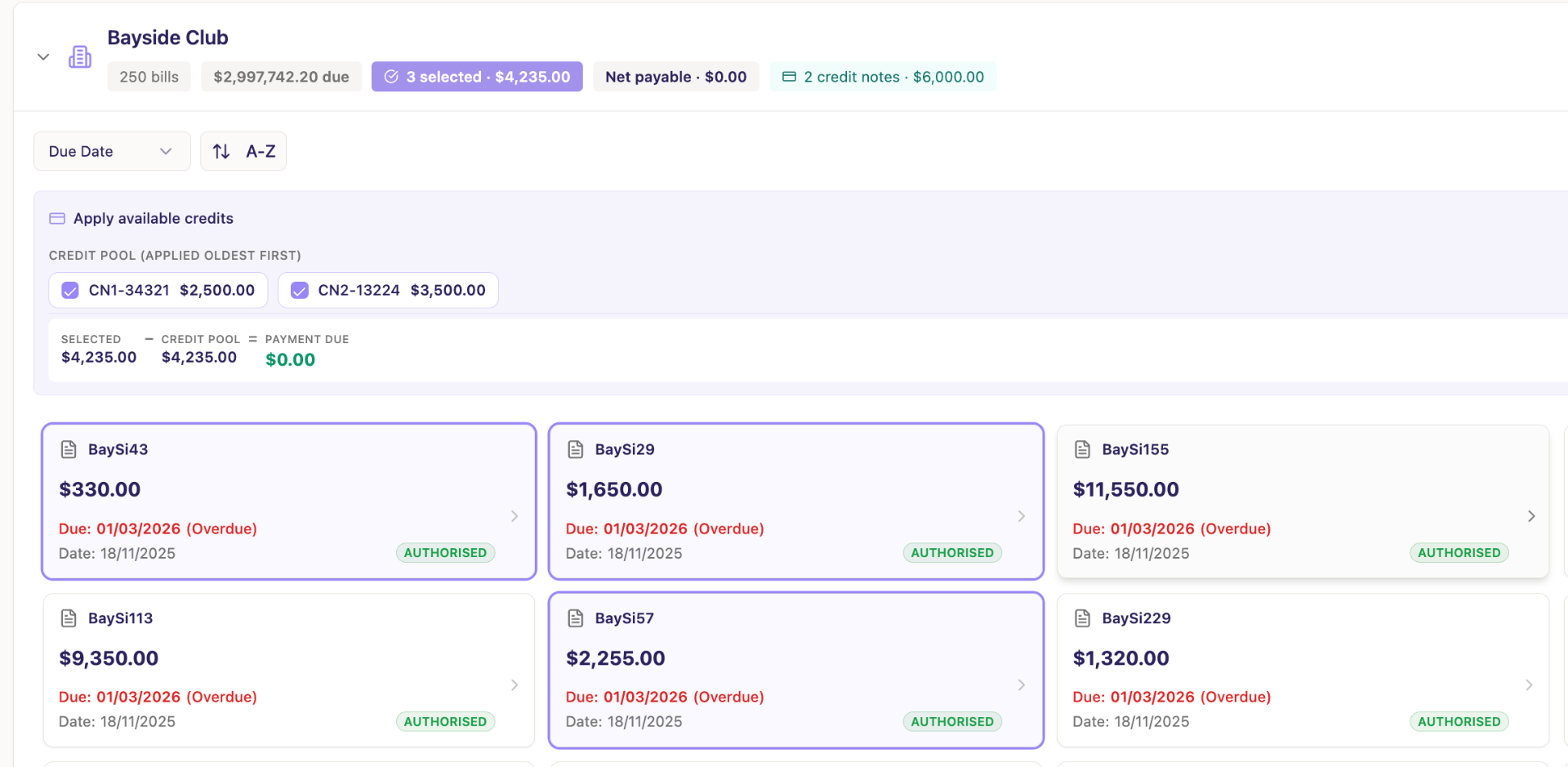
Multiple credit notes applied automatically, with the final net payable calculated before processing.
When multiple supplier credit notes are available, your team can choose which ones to apply. Batchly also supports same-currency credit allocation, so USD credit notes can be applied against USD bills in the same workflow.
That means your team can settle bills in three ways:
- Surface available supplier credit notes per supplier during the workflow
- Choose which credit notes to apply when multiple credits are available
- Credit only — where the bill is fully covered by available credits
- Credit plus cash — where credits reduce the bill and the remaining balance is paid
- Cash only — where no credit applies and the full amount is paid as normal
- Generate remittances that clearly show credits and cash applied
Full payment workflow availability depends on region, but the credit allocation workflow shown here is what removes the manual work.
This removes the separate manual allocation step and makes it easier to trust the final outcome before you process anything.
Examples
Credit only
$800 bill
− $800 credit note
= $0 cash paid
Credit + cash
$1,200 bill
− $800 credit note
= $400 paid
Cash only
$1,200 bill
− no available credit
= $1,200 paid
Batchly calculates the outcome automatically before the workflow is completed.
Here’s how that looks when a credit only partially covers a bill:
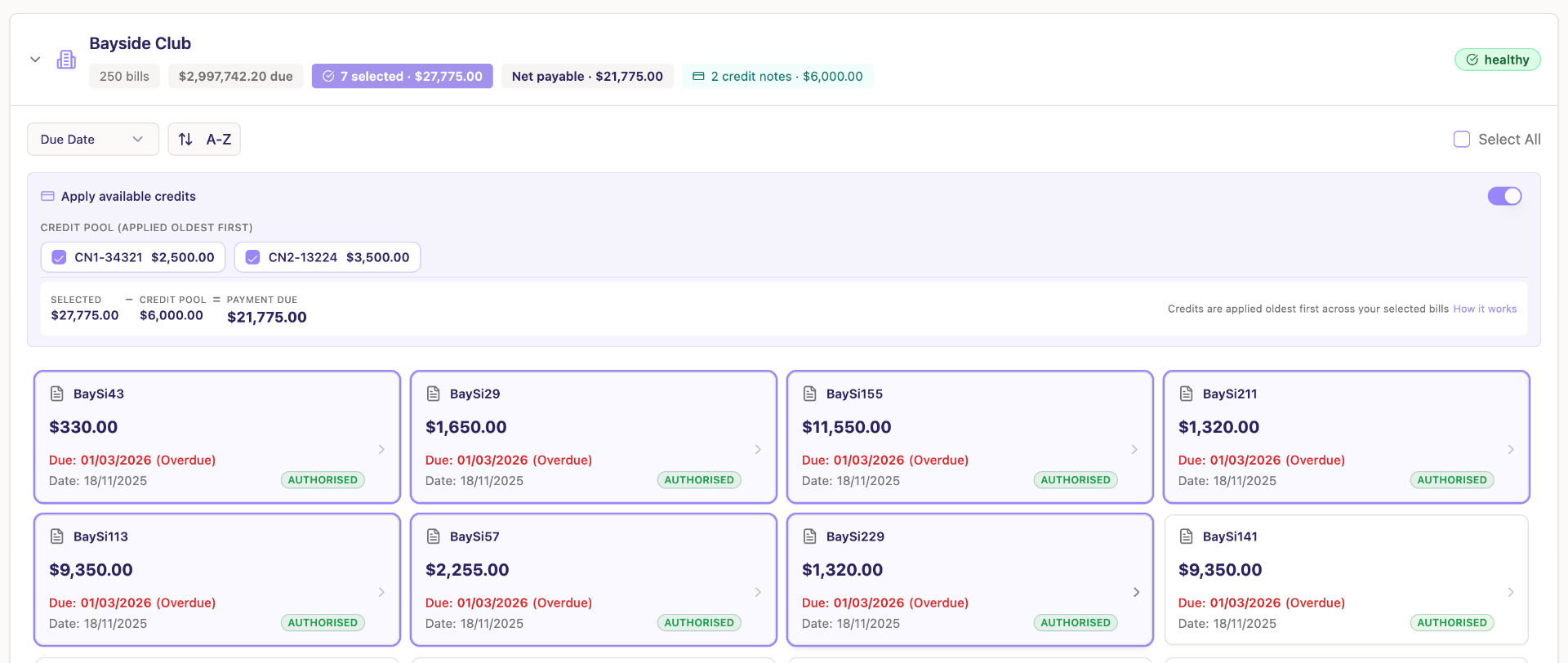
Credits reduce the bill automatically, with the remaining balance clearly shown before payment.
Why This Matters
When credits are handled as part of the workflow:
- You don’t miss credits
- You don’t overpay suppliers
- You don’t spend hours allocating before every run
- You don’t need to second-guess what was paid
You can settle bills with credits, cash, or a mix — with the correct outcome already calculated.
Frequently asked questions
How do you allocate a supplier credit note to a bill in Xero?
Open Purchases, select Bills and the Awaiting Payment tab, then open the supplier credit note. From the options menu choose Allocate Credit, enter the amount beside the relevant bill, and select Allocate Credit to confirm.
Can you bulk allocate supplier credit notes in Xero?
No. Xero does not currently provide a built-in bulk allocation workflow. Supplier credit notes still need to be allocated manually to individual bills.
Do supplier credit notes reduce the amount payable automatically?
No. A supplier credit note must be allocated to a bill before it reduces the total payable in a batch payment run.
Why is supplier credit note allocation slow in Xero?
Because the process is manual. Teams must open each credit note, apply it to bills, and then recheck what is left to pay.
How does Batchly handle supplier credit notes?
Batchly applies supplier credit notes during the workflow, so teams can see what is covered by credit and what remains payable before processing.
If manual credit allocation slows your team down, Batchly handles that step inside the workflow.
Whether the outcome is credit only, credit plus cash, or cash only, your team can see it clearly before anything is processed.
Related reading
Xero Batch Payments: How to Pay More Than 200 Bills in Xero
How larger supplier payment runs stay structured while Xero remains the accounting system of record.
Read guideHow Many Suppliers Can You Pay in a Xero Batch Payment? (The Real Limits Explained)
The practical supplier and bill-selection limits teams encounter as Xero payment runs grow.
Read guideHow to Make Batch Payments in Xero (Step-by-Step for Growing Teams)
A practical step-by-step guide to preparing and completing supplier batch payments in Xero.
Read guideThe Xero 200-Bill Limit: What It Is, Why It Exists, and How High-Volume Teams Break Through It
What Xero's 200-bill cap means for high-volume payment runs and how finance teams work around it.
Read guideHow credit notes affect batch payments
How supplier credit notes affect the final cash amount in a Xero batch payment run.
Read guideHandle Xero Credit Allocation Without Manual Work
Batchly handles credit allocation inside the workflow, so your team can remove manual allocation work and see the correct outcome before processing.
Available for Xero teams across Australia, New Zealand, the United States, Ireland, and the United Kingdom.
- Apply credit notes automatically inside the workflow
- Choose which credit notes to apply when multiple credits are available
- Handle credit only, credit plus cash, or cash only outcomes
- Support same-currency credit allocation, including USD to USD
- Keep one clear record of what was offset and what was paid